UNITED STATES
SECURITIES AND EXCHANGE COMMISSION
Washington, D.C. 20549
FORM
| Quarterly report pursuant to Section 13 or 15(d) of the Securities Exchange Act of 1934 |
For
the quarterly period ended
| Transition report pursuant to Section 13 or 15(d) of the Securities Exchange Act of 1934 |
For the transition period from __________ to ____________.
Commission
File Number
(Exact name of registrant as specified in its charter)
| (State or other jurisdiction of incorporation or organization) | (I.R.S. Employer Identification Number) |
N/A1
(Address of principal executive offices)
(Registrant’s telephone number, including area code)
Securities registered pursuant to Section 12(b) of the Act:
| Title of Each Class | Trading Symbol | Name of exchange on which registered | ||
Indicate
by check mark whether the registrant (1) has filed all reports required to be filed by Section 13 or 15(d) of the Securities Exchange
Act of 1934 during the preceding 12 months (or for such shorter period that the registrant was required to file such reports), and (2)
has been subject to such filing requirements for the past 90 days.
Indicate
by check mark whether the registrant has submitted electronically every Interactive Data File required to be submitted pursuant to Rule
405 of Regulation S-T during the preceding 12 months (or for such shorter period that the registrant was required to submit such files).
Indicate by check mark whether the registrant is a large accelerated filer, an accelerated filer, a non-accelerated filer, a smaller reporting company or an emerging growth company. See the definitions of “large accelerated filer,” “accelerated filer,” “smaller reporting company” and “emerging growth company” in Rule 12b-2 of the Exchange Act.
| Large accelerated filer ☐ | Accelerated filer ☐ |
| Smaller
reporting company | |
| Emerging
growth company |
If an emerging growth company, indicate by check mark if the registrant has elected not to use the extended transition period for complying with any new or revised financial accounting standards provided pursuant to Section 13(a) of the Exchange Act. ☐
Indicate
by check mark whether the registrant is a shell company (as defined in Rule 12b-2 of the Exchange Act). Yes ☐ No
As of May 8, 2026, the registrant had shares of common stock outstanding.
1
Effective as of July 1, 2024, the Company became a fully remote
company. We do not maintain a principal executive office. For purposes of compliance with applicable requirements of the Securities Act
of 1933, as amended, and the Securities Exchange Act of 1934, as amended, any stockholder communication required to be sent to the Company’s
principal executive offices may be directed to
GT BIOPHARMA, INC.
FORM 10-Q
For the Three Months Ended March 31, 2026
Table of Contents
| 2 |
GT BIOPHARMA, INC.
Condensed Balance Sheets
| March 31, 2026 | December 31, 2025 | |||||||
| (Unaudited) | ||||||||
| ASSETS | ||||||||
| Current assets | ||||||||
| Cash and cash equivalents | $ | $ | ||||||
| Restricted cash | ||||||||
| Deferred offering costs | ||||||||
| Prepaid expenses and other current assets | ||||||||
| TOTAL ASSETS | $ | $ | ||||||
| LIABILITIES AND STOCKHOLDERS’ EQUITY | ||||||||
| Current liabilities | ||||||||
| Accounts payable | $ | $ | ||||||
| Accrued expenses | ||||||||
| Warrant liability | ||||||||
| Total Current Liabilities | ||||||||
| Stockholders’ Equity | ||||||||
| Convertible Preferred stock, par value $, shares authorized: Series C - shares issued and outstanding as of March 31, 2026 and December 31, 2025, respectively | ||||||||
| Series L - and shares issued and outstanding as of March 31, 2026 and December 31, 2025, respectively | ||||||||
| Common stock, par value $, shares authorized, and shares issued and outstanding as of March 31, 2026 and December 31, 2025, respectively | ||||||||
| Additional paid in capital | ||||||||
| Accumulated deficit | ( | ) | ( | ) | ||||
| Total Stockholders’ Equity | ||||||||
| TOTAL LIABILITIES AND STOCKHOLDERS’ EQUITY | $ | $ | ||||||
The accompanying notes are an integral part of these unaudited condensed financial statements.
| 3 |
GT BIOPHARMA, INC.
Condensed Statements of Operations
| The Three Months | ||||||||
| Ended March 31, | ||||||||
| 2026 | 2025 | |||||||
| (Unaudited) | (Unaudited) | |||||||
| Revenues | $ | $ | ||||||
| Operating Expenses: | ||||||||
| Research and development | $ | $ | ||||||
| Selling, general and administrative | ||||||||
| Loss from Operations | ( | ) | ( | ) | ||||
| Other Income (Expense) | ||||||||
| Interest income | ||||||||
| Interest expense | ( | ) | ||||||
| Change in fair value of warrant liability | ||||||||
| Gain on settlement of vendor payable | ||||||||
| Total Other Income, net | ||||||||
| Net Loss | ( | ) | ( | ) | ||||
| Dividend on preferred stock | ( | ) | ||||||
| Deemed dividend | ( | ) | ||||||
| Net Loss attributable to common stockholders’ | $ | ( | ) | $ | ( | ) | ||
| Net Loss Per Share - Basic and Diluted | $ | ) | $ | ) | ||||
| Weighted average common shares outstanding - basic and diluted | ||||||||
The accompanying notes are an integral part of these unaudited condensed financial statements.
| 4 |
GT BIOPHARMA, INC.
CONDENSED STATEMENTS OF STOCKHOLDERS’ EQUITY (DEFICIT)
For The Three Months Ended March 31, 2026 and 2025 (Unaudited):
Series C Preferred Shares |
Series L Preferred Shares | Common Shares | Additional Paid in | Accumulated | Total Shareholders’ Equity | |||||||||||||||||||||||||||||||
| Shares | Amount | Shares | Amount | Shares | Amount | Capital | Deficit | (Deficit) | ||||||||||||||||||||||||||||
| Balance, December 31, 2025 | $ | $ | $ | $ | $ | ( | ) | $ | ||||||||||||||||||||||||||||
| Exercise of warrants for cash, net | - | - | ||||||||||||||||||||||||||||||||||
| Series L convertible preferred stock and warrants issued for cash, net | - | - | ||||||||||||||||||||||||||||||||||
| Conversion of Series L convertible preferred stock into common stock | - | ( | ) | ( | ) | |||||||||||||||||||||||||||||||
| Dividend on Series L convertible preferred stock | - | - | ( | ) | ||||||||||||||||||||||||||||||||
| Fair value of vested stock options | - | - | - | |||||||||||||||||||||||||||||||||
| Net loss | - | - | - | ( | ) | ( | ) | |||||||||||||||||||||||||||||
| Balance, March 31, 2026 | $ | $ | $ | $ | $ | ( | ) | $ | ||||||||||||||||||||||||||||
Series C Preferred Shares | Series L Preferred Shares | Common Shares | Additional Paid in | Accumulated | Total Shareholders’ Equity | |||||||||||||||||||||||||||||||
| Shares | Amount | Shares | Amount | Shares | Amount | Capital | Deficit | (Deficit) | ||||||||||||||||||||||||||||
| Balance, December 31, 2024 | $ | $ | $ | $ | $ | ( | ) | $ | ( | ) | ||||||||||||||||||||||||||
| Exercise of warrants for cash, net | - | - | ||||||||||||||||||||||||||||||||||
| Issuance of prefunded warrant in settlement of vendor payable | - | - | - | |||||||||||||||||||||||||||||||||
| Fair value of vested stock options | - | - | - | |||||||||||||||||||||||||||||||||
| Net loss | - | - | - | ( | ) | ( | ) | |||||||||||||||||||||||||||||
| Balance, March 31, 2025 | $ | $ | $ | $ | $ | ( | ) | $ | ( | ) | ||||||||||||||||||||||||||
The accompanying notes are an integral part of these unaudited condensed financial statements.
| 5 |
GT BIOPHARMA, INC.
Condensed Statements of Cash Flows
| For The Three Months Ended | ||||||||
| March 31, | ||||||||
| 2026 | 2025 | |||||||
| (Unaudited) | (Unaudited) | |||||||
| CASH FLOWS FROM OPERATING ACTIVITIES | ||||||||
| Net loss | $ | ( | ) | $ | ( | ) | ||
| Adjustments to reconcile net loss to net cash used in operating activities: | ||||||||
| Stock based compensation | ||||||||
| Change in fair value of warrant liability | ( | ) | ( | ) | ||||
| Changes in operating assets and liabilities: | ||||||||
| (Increase) Decrease in prepaid expenses | ( | ) | ||||||
| Increase (Decrease) in accounts payable and accrued expenses | ( | ) | ||||||
| Net Cash Used in Operating Activities | ( | ) | ( | ) | ||||
| CASH FLOWS FROM INVESTING ACTIVITIES | ||||||||
| CASH FLOWS FROM FINANCING ACTIVITIES | ||||||||
| Exercise of warrants for cash, net | ||||||||
| Proceeds from issuance of Series L convertible preferred stock and warrants, net | ||||||||
| Net Cash Provided by Financing Activities | ||||||||
| Net Increase (Decrease) in Cash and Cash Equivalents and Restricted Cash | ( | ) | ||||||
| Cash and Cash Equivalents and Restricted Cash at Beginning of Period | ||||||||
| Cash and Cash Equivalents and Restricted Cash at End of Period | $ | $ | ||||||
| SUPPLEMENTAL DISCLOSURES OF CASH FLOW INFORMATION: | ||||||||
| Cash paid during the period for: | ||||||||
| Interest | $ | $ | ||||||
| Income taxes | $ | $ | ||||||
| SUPPLEMENTAL DISCLOSURES OF NON-CASH INVESTING AND FINANCING ACTIVITIES | ||||||||
| Fair value of prefunded warrant and common stock to settle vendor payable | $ | $ | ||||||
The accompanying notes are an integral part of these unaudited condensed financial statements.
| 6 |
GT BIOPHARMA, INC.
NOTES TO UNAUDITED CONDENSED FINANCIAL STATEMENTS
Three Months Ended March 31, 2026 and 2025 (Unaudited)
Note 1 – Organization and Going Concern Analysis
Organization
GT Biopharma, Inc. (the “Company”) is a clinical stage biopharmaceutical company focused on the development and commercialization of novel immune-oncology products based on our proprietary Tri-specific Killer Engager (“TriKE®”), and Tetra-specific Killer Engager (“Dual Targeting TriKE®”) platforms. The Company’s TriKE® and Dual Targeting TriKE® platforms generate proprietary therapeutics designed to harness and enhance the cancer killing abilities of a patient’s own natural killer cells (“NK cells”).
The corporate predecessor of GT Biopharma, Inc, Diagnostic Data, Inc., was incorporated in the state of California in 1965. Diagnostic Data, Inc. changed its incorporation to the state of Delaware on December 21, 1972 and changed its name to DDI Pharmaceuticals, Inc. on March 11, 1985. On September 7, 1994, DDI Pharmaceuticals, Inc. merged with International BioClinical, Inc. and Bioxytech S.A. and changed its name to OXIS International, Inc. On July 17, 2017, OXIS International, Inc. changed its name to GT Biopharma, Inc.
Throughout this Quarterly Report on Form 10-Q, the terms “GTBP,” “we,” “us,” “our,” “the Company” and “our Company” refer to GT Biopharma, Inc.
The GT Biopharma logo, TriKE®, and other trademarks or service marks of GT Biopharma, Inc. appearing in this quarterly report are the property of the Company. This quarterly report on Form 10-Q also contains registered marks, trademarks and trade names of other companies. All other trademarks, registered marks and trade names appearing herein are the property of their respective holders.
Going Concern Analysis
The
accompanying unaudited condensed financial statements have been prepared assuming that the Company will continue as a going concern.
The Company does not have any product candidates approved for sale and has not generated any revenue from its product sales. The Company
has sustained operating losses since inception, and expects such losses to continue into the foreseeable future. Historically, the Company
has financed its operations through public and private sales of common stock, issuances of preferred and common stock, issuances of convertible
debt instruments, and strategic collaborations. For the three months ended March 31, 2026, the Company recorded a net loss of approximately
$
The unaudited condensed financial statements do not include any adjustments that might be necessary if the Company is unable to continue as a going concern. Accordingly, the unaudited condensed financial statements have been prepared on the basis that assumes the Company will continue as a going concern and which contemplates the realization of assets and satisfaction of liabilities and commitments in the ordinary course of business.
The Company has evaluated the significance of the uncertainty regarding the Company’s financial condition in relation to its ability to meet its obligations, which has raised substantial doubt about the Company’s ability to continue as a going concern. While it is very difficult to estimate the Company’s future liquidity requirements, the Company believes if it is unable to obtain additional financing, existing cash resources will not be sufficient to enable it to fund the anticipated level of operations through one year from the date the accompanying unaudited condensed financial statements are issued. There can be no assurances that the Company will be able to secure additional financing on acceptable terms. In the event the Company does not secure additional financing, the Company will be forced to delay, reduce, or eliminate some or all of its discretionary spending, which could adversely affect the Company’s business prospects, ability to meet long-term liquidity needs and the ability to continue operations.
| 7 |
Note 2 – Summary of Significant Accounting Policies
Basis of Presentation
The accompanying condensed financial statements are unaudited. These unaudited interim condensed financial statements have been prepared in accordance with accounting principles generally accepted in the United States of America (“GAAP”) and applicable rules and regulations of the Securities and Exchange Commission (“SEC”) regarding interim financial reporting. Certain information and note disclosures normally included in the financial statements prepared in accordance with GAAP have been condensed or omitted pursuant to such rules and regulations. Accordingly, these unaudited interim condensed financial statements should be read in conjunction with the financial statements and notes thereto contained in the Company’s Annual Report on Form 10-K for the fiscal year ended December 31, 2025 filed with the SEC on March 2, 2026 (the “2025 Annual Report”). The balance sheet as of December 31, 2025 included herein, was derived from the audited financial statements as of that date.
In the opinion of management, the accompanying unaudited condensed financial statements contain all adjustments necessary to fairly present the Company’s financial position and results of operations for the interim periods reflected. Except as noted, all adjustments contained herein are of a normal recurring nature. Results of operations for the fiscal periods presented herein are not necessarily indicative of fiscal year-end results.
Accounting Estimates
The preparation of financial statements in conformity with GAAP requires management to make estimates and assumptions that affect the reported amounts of assets and liabilities and disclosure of contingent assets and liabilities at the date of the financial statements and the reported amounts of revenues and expenses during the reporting period. Actual results could differ from those estimates. Significant estimates include management’s estimates for continued liquidity, accruals for potential liabilities, assumptions used in deriving the fair value of warrant liabilities, valuation of equity instruments issued for debt and services and realization of deferred tax assets.
Cash Equivalents
The
Company considers highly liquid investments with maturities of three months or less at the date of acquisition as cash equivalents in
the accompanying unaudited condensed financial statements. At March 31, 2026 and December 31, 2025, total cash equivalents which consist
of money market funds and treasuries with maturities of three months or less, amounted to approximately $
Restricted Cash
As of March 31, 2026, the Company has classified certain cash balances as restricted cash in its unaudited condensed balance sheets. The Company’s restricted cash is deposited in a financial institution and held as a collateral for a credit card agreement with the same financial institution.
Deferred Offering Costs
The
Company capitalizes the fair value of equity instruments granted and certain legal, accounting and other third-party fees that are directly
related to the Company’s in-process equity financings until such financings are consummated. After consummation of an equity financing,
these costs are recorded in stockholders’ equity as a reduction of additional paid-in capital generated as a result of the offering.
Should a planned equity financing be abandoned, terminated or significantly delayed, the deferred offering costs are immediately written
off to operating expenses. As of March 31, 2026, there was $
Stock-Based Compensation
The Company periodically issues stock-based compensation to officers, directors, employees, and consultants for services rendered. Such issuances vest and expire according to terms established at the issuance date.
Stock-based payments to officers, directors, employees, and consultants in exchange for goods and services, which include grants of employee stock options, are recognized in the financial statements based on their grant date fair values in accordance with ASC 718, Compensation-Stock Compensation. Stock based payments to officers, directors, employees, and consultants, which are generally time vested, are measured at the grant date fair value and depending on the conditions associated with the vesting of the award, compensation cost is recognized on a straight-line or graded basis over the vesting period. Recognition of compensation expense for non-employees is in the same period and manner as if the Company had paid cash for the services. The fair value of stock options granted is estimated using the Black-Scholes option-pricing model, which uses certain assumptions related to risk-free interest rates, expected volatility, expected life, and future dividends. The assumptions used in the Black-Scholes option pricing model could materially affect compensation expense recorded in future periods.
Research and Development Expenses
Costs incurred for research and development are expensed as incurred. The salaries, benefits, and overhead costs of personnel conducting research and development of the Company’s products are included in research and development expenses. Purchased materials that do not have an alternative future use are also expensed. Purchased materials that have an alternative future are classified as a prepaid expense and periodically reviewed.
| 8 |
Basic earnings (loss) per share is computed using the weighted-average number of common shares outstanding during the period. Diluted earnings (loss) per share is computed using the weighted-average number of common shares and the dilutive effect of contingent shares outstanding during the period. Potentially dilutive contingent shares, which primarily consist of stock issuable upon exercise of stock options and warrants, and the conversion of Series L Preferred Stock, have been excluded from the diluted loss per share calculation because their effect is anti-dilutive.
During
the three months ended March 31, 2026, the Company recorded dividends on Series L Preferred Stock of $
March 31, 2026 (Unaudited) | March 31, 2025 (Unaudited) | |||||||
| Series L Preferred Stock 1 | ||||||||
| Options to purchase common stock | ||||||||
| Warrants to purchase common stock | ||||||||
| Total anti-dilutive securities | ||||||||
| 1 |
Concentration
Cash
is deposited in one financial institution. The balances held at this financial institution at times may be in excess of Federal Deposit
Insurance Corporation (“FDIC”) insurance limits of up to $
Segment Information
The Company’s Chief Executive Officer and President (“CEO”) is our chief operating decision maker (“CODM”) and evaluates performance and makes operating decisions about allocating resources based on financial data presented on a consolidated basis. Because our CODM evaluates financial performance on a consolidated basis, the Company has determined that it operates as a single reportable segment composed of the financial results of GT Biopharma, Inc.
Recent Accounting Pronouncements
In November 2024, the FASB issued ASU 2024-03, Income Statement-Reporting Comprehensive Income-Expense Disaggregation Disclosures (Subtopic 220-40): Disaggregation of Income Statement Expenses, requiring public entities to disclose additional information about specific expense categories in the notes to the financial statements on an interim and annual basis. ASU 2024-03 is effective for fiscal years beginning after December 15, 2026, and for interim periods beginning after December 15, 2027, with early adoption permitted. The Company is currently evaluating the impact of adopting ASU 2024-03.
The Company’s management has evaluated all the recently issued, but not yet effective, accounting standards and guidance that have been issued or proposed by the FASB or other standards-setting bodies through the filing date of these financial statements and does not believe the future adoption of any such pronouncements will have a material effect on the Company’s financial position and results of operations.
Note 3 – Stockholders’ Equity (Deficit)
The Company’s authorized capital as of March 31, 2026 was shares of common stock, par value $ per share, and shares of preferred stock, par value $ per share.
2025 Private Placement of Equity Facility (the “Committed Equity Facility”)
On
May 14, 2025, and as amended on June 10, 2025, the Company entered into a common shares purchase agreement (the “Common Shares
Purchase Agreement”) with investors (collectively, the “Investors”) relating to the Committed Equity Facility. Pursuant
to the Common Shares Purchase Agreement, the Company has the right from time to time at its option to sell to the Investors up to $
| 9 |
Sales of the shares of common stock to the Investors under the Common Shares Purchase Agreement, and the timing of any sales, will be determined by the Company from time to time in its sole discretion and will depend on a variety of factors, including, among other things, market conditions, the trading price of the common stock and determinations by the Company regarding the use of proceeds from the sale of such shares of common stock. The net proceeds from any sales under the Common Shares Purchase Agreement will depend on the frequency with, and prices at, which the shares of common stock are sold to the Investors.
The
purchase price of the shares of common stock that the Company elects to sell to the Investors pursuant to the Common Shares Purchase
Agreement will be
In
connection with the execution of the Common Shares Purchase Agreement, the Company agreed to issue to the Investors pre-funded warrants
to purchase an aggregate of
2025 Warrant Inducement Transaction
On
February 26, 2025, the Company received gross proceeds of $
The
Inducement Warrants consist of (i) new Series A Inducement Warrants, representing warrants to purchase up to
The Company determined that under ASC 815, the 2025 inducement and placement agent warrants are considered indexed to the Company’s own stock and eligible for an exception from derivative accounting. Accordingly, the fair value of the 2025 inducement and placement agent warrants are classified as equity.
The
Company recognized the aggregate effect of the modification of warrants and grant of inducement warrants of $
Preferred Stock
Series C Preferred Stock
As of March 31, 2026, there were shares of series C preferred stock, par value $ per share (the “Series C Preferred Stock”) issued and outstanding.
As a result of numerous reverse stock-splits in previous years and the agreement terms for adjusting the rights of the related shares, the shares of Series C Preferred Stock are convertible into an infinitesimal amount of common stock, have no voting rights, and in the event of liquidation, the holders of the Series C Preferred Stock would not participate in any distribution of the assets or surplus funds of the Company. The holders of Series C Preferred Stock also are not currently entitled to any dividends if and when declared by the Board. No dividends to holders of the Series C Preferred Stock were declared or unpaid through March 31, 2026.
| 10 |
Series L Preferred Stock and Warrants
The Company previously issued Series L 10% Convertible Preferred Stock (the “Series L Preferred Stock”) and related warrants (the “2025 Warrants”) pursuant to a securities purchase agreement entered into in May 2025, as more fully described in the Company’s Annual Report on Form 10-K for the year ended December 31, 2025.
Activity During the Three Months Ended March 31, 2026
During the three months ended March 31, 2026, holders
exercised certain additional purchase rights issued pursuant to the May 2025 private
placement (the “Greenshoe Rights”) and purchased shares of Series L Preferred Stock with an aggregate stated value of $
The reduction in the conversion price constituted a dilutive issuance under the terms of the 2025 Warrants. Accordingly, the exercise price of the outstanding 2025 Warrants was reduced, and the number of shares underlying the 2025 Warrants was increased, such that the aggregate exercise price of the 2025 Warrants remained unchanged.
As of March 31, 2026, the Series L Preferred Stock
reflects the adjusted conversion price of $
For the three months ended March 31, 2026, the incremental change in the fair value of equity classified instruments upon the reduction of conversion and exercise prices was determined to be $, and was treated as a deemed dividend.
Dividends
During the three months ended March 31,
2026, the Company declared and paid dividends of approximately $
| 11 |
Note 4 – Common Stock Warrants and Options
Common Stock Warrants
Common stock warrant transactions for the three months ended March 31, 2026 were as follows:
| Three Months Ended March 31, 2026 | ||||||||
| Number of | Weighted Average | |||||||
| Warrants | Exercise Price | |||||||
| Warrants outstanding at December 31, 2025 | $ | |||||||
| Granted | ||||||||
| Anti-dilution adjustment (1) | ||||||||
| Forfeited/cancelled | ( | ) | ||||||
| Exercised | ( | ) | ||||||
| Warrants outstanding at March 31, 2026 | $ | |||||||
| Warrants exercisable at March 31, 2026 | $ | |||||||
| (1) |
The aggregate intrinsic value of all warrants outstanding and all warrants vested and exercisable as of March 31, 2026 was approximately $, in each case based on the fair value of the Company’s common stock on March 31, 2026.
Pursuant
to the May 2025 private placement of Series L Preferred Stock and 2025 Warrants the Company issued an aggregate of
Warrants outstanding as of March 31, 2026 are exercisable as follows:
| Warrants Outstanding and Exercisable as of March 31, 2026 | ||||||||||||||
Range of Exercise Price | Number Outstanding | Weighted Average Remaining Contractual Life (Years) | Weighted Average Exercise Price | |||||||||||
| $ | N/A | $ | ||||||||||||
Common Stock Options
In April 2022 the Company established the 2022 Omnibus Incentive Plan (the “Plan”). The Plan was approved by our Board and stockholders. The purpose of the Plan is to grant stock and options to purchase our common stock, and other incentive awards, to our employees, directors, and key consultants. On July 24, 2025, shareholders voted to increase the maximum number of shares of common stock that may be issued pursuant to awards granted under the Plan by shares. Pursuant to the increase, the maximum number of shares of common stock that may be issued pursuant to awards granted under the Plan is shares. The shares of our common stock underlying cancelled and forfeited awards issued under the Plan may again become available for grant under the Plan. As of March 31, 2026, there were stock options outstanding and shares of restricted stock granted in prior years under the Plan, which left shares available for grant under the Plan. The following table summarizes stock option transactions for the three months ended March 31, 2026:
| Three Months Ended March 31, 2026 | ||||||||
| Number of | Weighted Average | |||||||
| Options | Exercise Price | |||||||
| Options outstanding at December 31, 2025 | $ | |||||||
| Granted | ||||||||
| Forfeited/cancelled | ||||||||
| Exercised | ||||||||
| Options outstanding at March 31, 2026 | $ | |||||||
| Options exercisable at March 31, 2026 | $ | |||||||
| 12 |
The weighted average remaining contractual life of all options outstanding, and all options vested and exercisable as of March 31, 2026 was approximately years. Furthermore, the aggregate intrinsic value of all options outstanding and all options vested and exercisable as of March 31, 2026 was $, in each case based on the fair value of the Company’s common stock on March 31, 2026.
The total fair value of options that vested during the three months ended March 31, 2026 and 2025, was $ and $, respectively, and is included in selling, general and administrative expense in the accompanying unaudited condensed statements of operations. As of March 31, 2026, stock options were vested and exercisable and unvested compensation expense amounted to approximately $.
| Stock Options Exercisable as of March 31, 2026 | ||||||||||||||
Range of Exercise Price | Number Outstanding | Weighted Average Remaining Contractual Life (Years) | Weighted Average Exercise Price | |||||||||||
| $ | $ | |||||||||||||
Note 5 – Commitments and Contingencies
Litigation
The Company is involved in certain legal proceedings that arise from time to time in the ordinary course of our business. Except for income tax contingencies, we record accruals for contingencies to the extent that our management concludes that the occurrence is probable and that the related amounts of loss can be reasonably estimated. Legal expenses associated with the contingency are expensed as incurred. There is no current or pending litigation of any significance with the exception of the matters identified below that have arisen under, and are being handled in, the normal course of business:
Ohri Matter
On July 22, 2024, the Company filed an AAA Arbitration Demand against Manu Ohri, its former Chief Financial Officer. In the demand, the Company asserts claims against Mr. Ohri for breach of his fiduciary duties and breach of contract and seeks a declaratory judgment providing that the Company may characterize Mr. Ohri’s termination as “for cause” under his employment agreement, and that the Company may revoke the separation agreement entered into between the Company and Mr. Ohri prior to the Company learning of Mr. Ohri’s breaches. In addition to the declaratory judgment, the Company seeks damages arising from Mr. Ohri’s violations, and attorneys’ fees and any forum and arbitration fees. On September 3, 2024, Mr. Ohri filed both a general denial of the Company’s claims against him and counterclaims for breach of his employment agreement and separation agreement. The final hearing date, originally scheduled for June 10, 2025, was postponed to October 6-8, 2026, in order to allow the parties to mediate the dispute. Mediation was held on March 31, 2026.
| 13 |
TWF Global Matter
On
May 24, 2023, TWF Global, LLC (“TWF”) filed a Complaint in the California Superior Court for the County of Los Angeles naming
the Company as defendant. The complaint alleges that TWF is the holder of two Convertible Promissory Notes (“Notes”) and
that the Company did not deliver shares of common stock due on conversion in February 2021. TWF was seeking per diem liquidated damages
based on the terms of alleged Notes. On July 14, 2023, the Company filed a motion to dismiss for improper forum because the terms of
the Notes, as alleged, require disputes to be filed in New York state and federal courts. TWF voluntarily dismissed its complaint before
the California Superior Court of Los Angeles without prejudice. The Company subsequently filed a summons and complaint for interpleader
against TWF and Z-One, LLC before the Supreme Court of the State of New York County of New York, asking the Supreme Court to determine
if the Company’s shares of common stock should be registered to TWF or Z-One LLC, as both of these entities have made conflicting
demands for the shares. On February 5, 2024, the Company filed a motion for entry of default against TWF, seeking an order directing
the Company to register the shares of common stock in the name of Z-One, LLC and that the Company be released from all associated liability
and claims. The Court denied the motion without prejudice and agreed to reconsider the motion without further briefing upon the filing
of a supplemental party affidavit. On May 9, 2024, Z-One, LLC filed a motion for summary judgement seeking dismissal of the action, representing
that Z-One, LLC and TWF have settled their dispute over the entitlement to the Company’s shares of common stock and there is no
remaining dispute before the Court. On May 21, 2024, the Company filed a supplemental affidavit in support of its motion for entry of
default. On November 14, 2024, the Court held a hearing on the parties’ motions, at which the Court found that the motion for entry
of default was mooted by the settlement agreement between Z-One, LLC and TWF. The Court ordered that the case be dismissed. On February
17, 2025, Z-One, LLC filed a Summons with Notice in the Supreme Court of the State of New York, County of New York. The Company then
filed a demand that Z-One, LLC serve a complaint, and on June 25, 2025, Z-One, LLC filed a Complaint alleging that it is the holder,
either originally or by assignment, of a Convertible Note in the principal amount of $
Silberfein, DiPietro, and Werthman Trust Matters
On
July 8, 2025, Coby Silberfein filed a summons with notice in the State of New York Supreme Court for the County of New York naming
the Company as defendant seeking damages for breach of a securities purchase agreement and convertible note in the principal amount
of $
Significant Agreements
University of Minnesota
2023 Sponsored Research Agreement
On
May 20, 2024, the Company entered into a sponsored research agreement (the “2023 Sponsored Research Agreement”) with the
Regents of the University of Minnesota (the “University of Minnesota”), effective July 1, 2023. Payments totaling approximately
$
On
June 18, 2025, the 2023 Sponsored Research Agreement was amended to expire on December 31, 2025. In addition, payments amounting to $
On
March 26, 2026, the 2023 Sponsored Research Agreement was amended to expire on March 31, 2026. In addition, payments amounting to $
| 14 |
The
Company recorded an expense classified as research and development of approximately $
As of March 31, 2026, there were no outstanding commitments in relation to unbilled and unaccrued amounts from the University of Minnesota pursuant to the 2023 Sponsored Research Agreement for services that have not yet been rendered as of March 31, 2026.
2016 Exclusive Patent License Agreement
Effective
July 18, 2016, the Company entered into an exclusive patent license agreement with the University of Minnesota (as amended, the “2016
Exclusive Patent License Agreement”), to further develop and commercialize cancer therapies using TriKE® technology
developed by researchers at the University of Minnesota to target NK cells to cancer. Under the terms of the agreement, the Company receives
exclusive rights to conduct research and to develop, make, use, sell, and import TriKE® technology worldwide for the treatment
of any disease, state, or condition in humans. The Company is responsible for obtaining all permits, licenses, authorizations, registrations,
and regulatory approvals required or granted by any governmental authority anywhere in the world that is responsible for the regulation
of products such as the TriKE® technology, including without limitation the FDA and the European Agency for the Evaluation
of Medicinal Products in the European Union. The agreement requires an upfront payment of $
Effective
May 13, 2024, the Company entered into an amended and restated exclusive patent license agreement with the University of Minnesota (the
“A&R 2016 Exclusive Patent License Agreement”). The amendment requires an upfront payment of $
The Company did not record any expense classified as research and development, pursuant to the A&R 2016 Exclusive Patent License Agreement, for the three months ended March 31, 2026 and 2025.
2021 Exclusive License Agreement
Effective
March 26, 2021, the Company entered into an exclusive license agreement with the University of Minnesota (the “2021 Exclusive Patent
License Agreement”), specific to the B7H3 targeted TriKE®. The agreement requires an upfront payment of $
The Company did not record any expense classified as research and development, pursuant to the 2021 Exclusive License Agreement, for the three months ended March 31, 2026 and 2025.
| 15 |
2024 GTB-3650 Clinical Trial Agreement
On
November 18, 2024, the Company entered into an investigator initiated clinical trial agreement (the “2024 Clinical Trial Agreement”)
with the University of Minnesota, pursuant to which, the University of Minnesota shall sponsor an IND application for IND 165546 GTB-3650
(the “Research Program”) and shall serve as a sponsor investigator for a phase 1 clinical trial entitled, “GTB-3650
(CD16/IL-15/CD33) Tri-Specific Killer Engager (TriKE) for the Treatment of High Risk Myelodysplastic Syndromes (MDS), Refractory/Relapsed
Acute Myeloid Leukemia (AML), and Minimal Residual Disease in AML,” designed by the University of Minnesota (the “Study”).
The Research Program is being conducted for clinical research use. The budget for the Study, including without limitations, funding and
resources, provides for up to approximately $
The
Company recorded an expense classified as research and development of approximately $
As
of March 31, 2026, the Company’s commitments in relation to unbilled and unaccrued amounts from the University of Minnesota pursuant
to the 2024 Clinical Trial Agreement for services that have not yet been rendered as of March 31, 2026, amounted to approximately $
Advisory Agreement
On
June 30, 2025, the Company entered into an Advisory Agreement (the “Advisory Agreement”) with PDPC Advisors Inc.
(“PDPC”), to perform certain advisory services. Under the Advisory Agreement cash payments amounting to $
Contingency – NASDAQ Matters
On
November 20, 2025, the Company received a letter (the “2025 Letter”) from the Nasdaq Listing Qualifications Staff
(the “Staff”) notifying the Company that its common stock, $
par value per share
In accordance with Nasdaq Listing Rule 5810(c)(3)(A), the Company was provided a compliance period of 180 calendar days from the date of the Letter, or until May 19, 2026 (the “Compliance Period”), to regain compliance with the Minimum Bid Price requirement. On May 12, 2026, the Company submitted a request to Nasdaq for an additional 180-day period (the “Second Compliance Period”) to provide additional time for the Company to demonstrate compliance with the Minimum Bid Price Requirement, including by effecting a reverse stock split of its common stock, if necessary. If such request is granted, and if at any time during such Second Compliance Period, the closing bid price of the Company’s common stock is at least $ per share for a minimum of ten consecutive business days (unless the Staff exercises its discretion to extend this ten business day period pursuant to Nasdaq Listing Rule 5810(c)(3)(H)), the Staff will provide the Company written confirmation of compliance with the Minimum Bid Price, and the matter will be closed.
| 16 |
If the Staff determines that the Company is not eligible for such Second Compliance Period or the Company will not be able to cure the deficiency with the Minimum Bid Price Requirement within the allotted compliance period, the Company’s stock will be subject to delisting.
The Company intends to monitor the closing bid price of the common stock and assess its available options to regain compliance with the Minimum Bid Price requirement and continue listing on The Nasdaq Capital Market. There can be no assurance that the Company will be able to regain compliance with the Minimum Bid Price requirement or will otherwise be in compliance with other applicable Nasdaq listing rules.
If our common stock is delisted from Nasdaq, our ability to raise capital through public offerings of our securities and to finance our operations could be adversely affected. We also believe that delisting would likely result in decreased liquidity and/or increased volatility in our common stock and could harm our business and future prospects. In addition, we believe that, if our common stock is delisted, our stockholders would likely find it more difficult to obtain accurate quotations as to the price of our common stock and it may be more difficult for stockholders to buy or sell our common stock at competitive market prices, or at all.
Note 6 – Segment Information
The
Company operates and manages its business as
The Company’s CODM reviews financial information presented and decides how to allocate resources based on net income (loss). Net income (loss) is used for evaluating financial performance.
Significant segment expenses include research and development, salaries, insurance, and stock-based compensation. Operating expenses include all remaining costs necessary to operate our business, which primarily include external professional services and other administrative expenses. The following table presents the significant segment expenses and other segment items regularly reviewed by our CODM:
Three Months Ended March 31, | ||||||||
| 2026 | 2025 | |||||||
| Research and development | $ | $ | ||||||
| Salaries | ||||||||
| Insurance | ||||||||
| Stock-based compensation | ||||||||
| Operating expenses | ||||||||
| Other income | ( | ) | ( | ) | ||||
| Net loss | $ | $ | ||||||
Note 7 – Subsequent Events
Conversion of Series L Preferred Stock
From April 1, 2026 through May 8, 2026, the holders of the Company’s Series L Preferred Stock have converted shares of Series L Preferred Stock into shares of common stock.
2026 GTB-5550 Clinical Trial Agreement
On
April 3, 2026, the Company entered into an Investigator Initiated Clinical Trial Agreement (the “2026 GTB-5550 Clinical Trial
Agreement”) with the University of Minnesota, pursuant to which, the University of Minnesota shall sponsor an
IND application for IND 169118 GTB-5550 (the “Research Program”) and shall serve as a sponsor investigator for a phase
1a/1b clinical trial entitled, “GTB-5550, a Camelid Nanobody B7-H3 Tri-Specific Killer Engager (camB7-H3 TriKE®), in
Select Advanced Solid Tumors That Failed Prior Therapy,” designed by the University of Minnesota (the “Study”).
Advisory Agreement
On
April 1, 2026, the Company entered into an Amended and Restated Advisory Agreement (the “Amended Advisory Agreement”)
with PDPC, to perform certain advisory services. Under the Amended Advisory Agreement cash payments amounting to $
NASDAQ Matters
On May 12, 2026, the Company submitted a request to Nasdaq for an additional 180-day period (the “Second Compliance Period”) to provide additional time for the Company to demonstrate compliance with the Minimum Bid Price Requirement, including by effecting a reverse stock split of its common stock, if necessary. If such request is granted, and if at any time during such Second Compliance Period, the closing bid price of the Company’s common stock is at least $ per share for a minimum of ten consecutive business days (unless the Staff exercises its discretion to extend this ten business day period pursuant to Nasdaq Listing Rule 5810(c)(3)(H)), the Staff will provide the Company written confirmation of compliance with the Minimum Bid Price, and the matter will be closed.
If the Staff determines that the Company is not eligible for such Second Compliance Period or the Company will not be able to cure the deficiency with the Minimum Bid Price Requirement within the allotted compliance period, the Company’s stock will be subject to delisting.
| 17 |
Item 2. Management’s Discussion and Analysis of Financial Condition and Results of Operations.
CAUTIONARY NOTICE REGARDING FORWARD-LOOKING STATEMENTS
Some of the statements in this Quarterly Report on Form 10-Q are “forward-looking statements” within the meaning of the safe harbor from liability established by the Private Securities Litigation Reform Act of 1995. Forward-looking statements include statements regarding our current beliefs, goals and expectations about matters such as our expected financial position and operating results, our business strategy and our financing plans. The forward-looking statements in this report are not based on historical facts, but rather reflect the current expectations of our management concerning future results and events. The forward-looking statements generally can be identified by the use of terms such as “believe,” “expect,” “anticipate,” “intend,” “plan,” “foresee,” “may,” “guidance,” “estimate,” “potential,” “outlook,” “target,” “forecast,” “likely” or other similar words or phrases. Similarly, statements that describe our objectives, plans or goals are, or may be, forward-looking statements. Forward-looking statements involve known and unknown risks, uncertainties and other factors that may cause our actual results, performance or achievements to be different from any future results, performance and achievements expressed or implied by these statements. We cannot guarantee that our forward-looking statements will turn out to be correct or that our beliefs and goals will not change. Our actual results could be very different from and worse than our expectations for various reasons. You should carefully review all information, including the discussion of risk factors under “Part I. Item 1A: Risk Factors” and “Part II. Item 7: Management’s Discussion and Analysis of Financial Condition and Results of Operations” of the Form 10-K for the year ended December 31, 2025. Any forward-looking statements in the Form 10-Q are made only as of the date hereof and, except as may be required by law, we do not have any obligation to publicly update any forward-looking statements contained in this Form 10-Q to reflect subsequent events or circumstances.
Overview
We are a clinical stage biopharmaceutical company focused on the development and commercialization of novel immuno-oncology products based on our proprietary Tri-specific Killer Engager (“TriKE®”), and Tetra-specific Killer Engager (“Dual Targeting TriKE®”) fusion protein immune cell engager technology platforms. Our TriKE® and Dual Targeting TriKE® platforms generate proprietary therapeutics designed to harness and enhance the cancer killing abilities of a patient’s own natural killer cells, (“NK cells”). Once bound to an NK cell, our moieties are designed to activate the NK cell to direct it to one or more specifically targeted proteins expressed on a specific type of cancer cell or virus infected cell, resulting in the targeted cell’s death. TriKE®s can be designed to target any number of tumor antigens, including B7-H3, HER2, CD33 and PDL1, on hematologic malignancies or solid tumors and do not require patient-specific customization. We believe our TriKE® and Dual Targeting TriKE® platforms that activate endogenous NK cells are potentially safer than T-cell immunotherapy because there is less cytokine release syndrome (CRS) and fewer neurological complications. Our preclinical data suggests that this is explained by the TriKE® dependent CD16 directed IL-15 proliferation of NK cells, with little effect on endogenous T cells.
We are using our TriKE® platform with the intent to bring to market immuno-oncology products that can treat a range of hematologic malignancies, solid tumors, and potentially autoimmune disorders. The platform is scalable, and we are implementing processes to produce investigational new drug (“IND”) ready moieties in a timely manner after a specific TriKE® conceptual design. Specific drug candidates can then be advanced into the clinic on our own or through potential collaborations with partnering companies. We believe our TriKE®s may have the ability, if approved for marketing, to be used as both monotherapy and in combination with other standard-of-care therapies.
Our initial work was conducted in collaboration with the Masonic Cancer Center at the University of Minnesota under a program led by Dr. Jeffrey Miller, Professor of Medicine, and the Interim Director at the Masonic Cancer Center. Dr. Miller, who also serves as our Consulting Senior Medical Director, is a recognized key opinion leader in the field of NK cell and IL-15 biology and their therapeutic potential. We have exclusive rights to the TriKE® platform and are generating additional intellectual property for specific moieties.
| 18 |
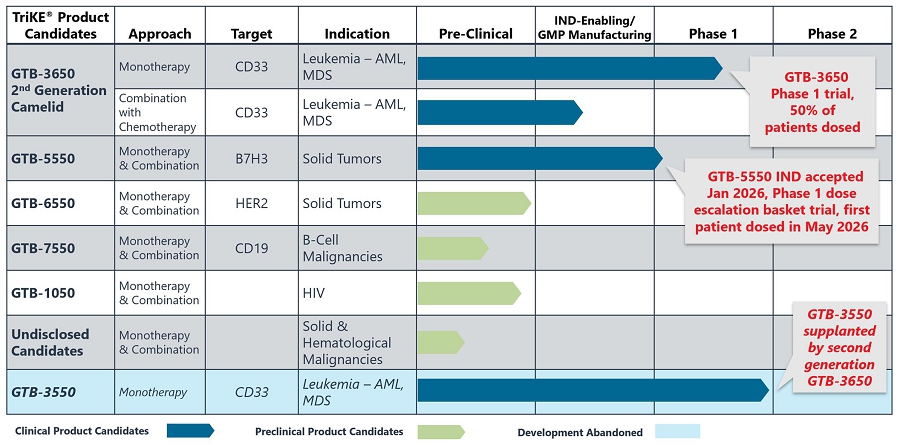
Our current product candidate pipeline (as of March 31, 2026) is summarized in the table below:
GTB-3550
GTB-3550 was our first TriKE® product candidate and its clinical development was suspended so that we could focus resources on second-generation TriKEs®. GTB-3550 is a tri-specific killer engager, or TriKE, comprised of two single-chain variable fragments (“scFv”) composed of the variable regions of the heavy and light chains of anti-CD16 and anti-CD33 antibodies and a modified form of IL-15. We studied this anti-CD16-IL-15-anti-CD33 TriKE® in CD33 positive leukemias, a marker expressed on tumor cells in acute myelogenous leukemia (“AML”) and myelodysplastic syndrome (“MDS”). The anti-CD33 antibody fragment in GTB-3550 was derived from the M195 humanized anti-CD33 scFv. We believe the approval of the antibody-drug conjugate gemtuzumab validates the targeting of CD33.
We previously announced the interim clinical trial results for GTB-3550, which showed significantly reduced CD 33+ bone marrow blast levels by 33.3%, 61.7%, 63.6%, 50% in Patient 5 (25 µg/kg/day), Patient 7 (50 µg/kg/day), Patient 9 (100 µg/kg/day), and Patient 11 (150 µg/kg/day), respectively. After the end of infusion, GTB-3550 and IL-15 concentrations declined rapidly with overall geometric mean terminal phase elimination half-life (T1/2) of 2.2 and 2.52 hours, respectively. There was minimal CRS resulting from hyperactivation of patient’s T-cell population at doses 5–150 µg/kg/day.
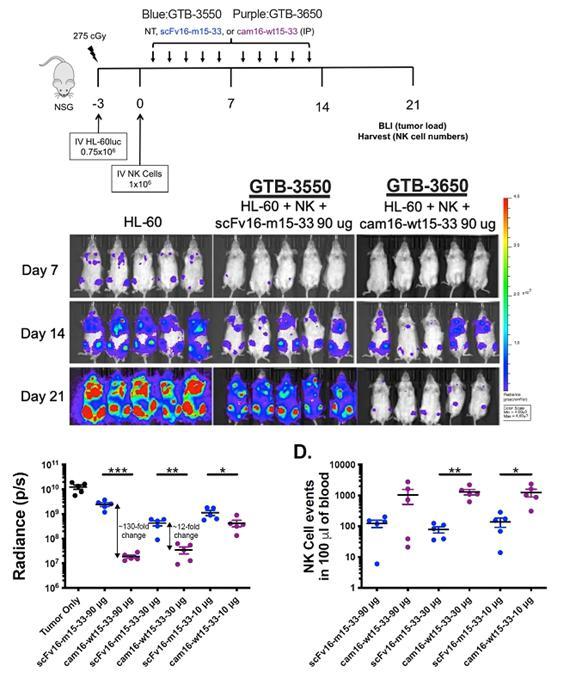
Despite the positive interim clinical trial results, GTB-3550 was replaced by a more potent next-generation camelid nanobody TriKE®, GTB-3650, that similarly targets CD33 on relapsed/refractory AML and high-risk MDS. A key difference between GTB-3550 and GTB-3650 is the incorporation of camelid antibody technology instead of a scFv; our preclinical experience showed markedly enhanced potency of TriKEs® comprised of camelid components. This is illustrated below by better tumor control of AML bearing animals with GTB-3650 (purple dots) compared to GTB-3550 (blue dots). This provided the rationale for pausing further development of GTB-3550 and moving over to solely develop the second-generation, camelid-based TriKE® platform.
| 19 |
Second Generation TriKE®s Utilize Camelid Nanobody Technology
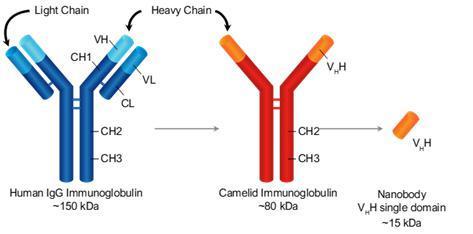
Our goal is to be a leader in immuno-oncology therapies targeting a broad range of indications including hematological malignancies and solid tumors. A key element of our strategy includes introducing a next-generation camelid nanobody platform. Camelid antibodies (often referred to as nanobodies) are smaller than human immunoglobulin, consisting of two heavy chains instead of two heavy and two light chains. These nanobodies have the potential to have greater affinity to target antigens, potentially resulting in greater potency. We are utilizing this camelid antibody structure for all of our new TriKE® product candidates.
To develop second generation TriKE®s, we designed a new humanized CD16 engager derived from a single-domain antibody. While scFvs consist of a heavy and a light variable chain joined by a linker, single-domain antibodies consist of a single variable heavy chain capable of engaging without the need of a light chain counterpart (see figure below).
| 20 |
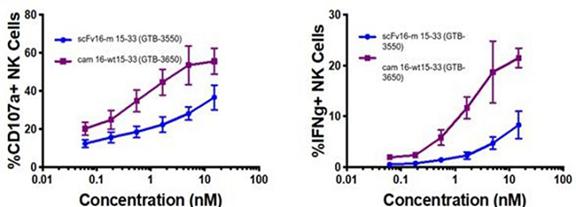
These single-domain antibodies are thought to have certain attractive features for antibody engineering, including physical stability, ability to bind deep grooves, and increased production yields, amongst others. Pre-clinical studies demonstrated increased NK cell activation against CD33+ targets including enhanced NK cell degranulation (% CD107a+) and IFNγ with the single-domain CD16 TriKE® (cam 16-wt15-33; GTB-3650) compared to the original TriKE® (scFv16-m 15-33; GTB-3550) (see figure below). This data was published by Dr. Felices M et al (2020) in Cancer Immunol Res.
CD33+ HL60 Targets in Killing Assays
The purple line represents the GTB-3650 and the blue line represents GTB-3550.
GTB-3650
GTB-3650 is a TriKE® which targets CD33 on the surface of myeloid leukemias and an agonistic camelid engager to the potent activating receptor on NK cells, CD16. Use of this engager enhances the activity of wild type IL-15 included in GTB-3650. The TriKE® approach provides a novel way to specifically target these tumors by leveraging NK cells, which have been shown to mediate relapse protection in this setting, in an anti-CD33-targeted fashion. We are advancing GTB-3650 to clinical studies based on pre-clinical data showing a marked increase in potency compared to GTB-3550, which we anticipate could lead to an enhanced efficacy signal in AML and MDS. We advanced GTB-3650 through requisite preclinical studies and filed an IND application with the U.S. Food and Drug Administration (the “FDA”) in December 2023. In late June 2024, the FDA cleared our IND Application for GTB-3650. We started study enrollment targeting patients with relapsed/refractory AML and high grade MDS on January 21, 2025, and we have advanced into the clinic with approximately 50% of patients dosed. This initial study is testing GTB-3650 as monotherapy testing administration 2 weeks on and two weeks off (to prevent NK cell exhaustion) for at least 2 cycles of therapy, as agreed on with the FDA.
| 21 |
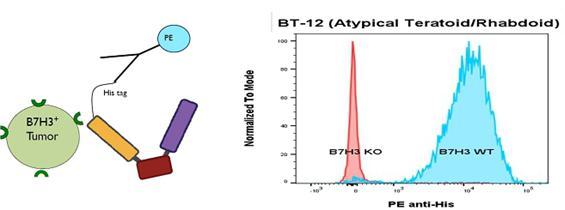
GTB-5550
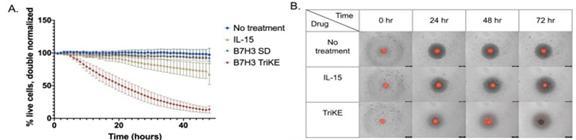
GTB-5550 is a B7-H3 targeted TriKE® which targets B7-H3 on the surface of advanced solid tumors (figure above). GTB-5550 is our first dual camelid TriKE®. B7-H3 is expressed on a broad spectrum of solid tumor malignancies, allowing our team to target these malignancies through GTB-5550. Pre-clinical work has shown that this molecule has NK-cell targeted activity against a variety of solid tumors, including head and neck cancer squamous cell carcinoma (figure below), prostate cancer, breast cancer, ovarian cancer, glioblastoma, and lung cancer (amongst others).
We advanced GTB-5550 through requisite preclinical studies and filed an IND application with the FDA in October 2023 with a written response from the FDA in December 2023. The main question from the FDA was regarding pre-clinical toxicology and a pivot to subcutaneous dosing. In early January 2026, the FDA cleared our IND Application for GTB-5550, and our first patient was dosed in May 2026. The initial trial is designed as a basket trial for patients with B7-H3+ solid tumors using Monday through Friday dosing (2 weeks on and 2 weeks off to prevent immune exhaustion).
GTB-7550
GTB-7550 TriKE® is a product candidate in development for the treatment of lupus and other autoimmune disorders. GTB-7550 TriKE® is a tri-specific molecule composed of a camelid nanobody that binds the CD16 receptor on NK cells, a scFv engager against CD19 on malignant and normal B cells, and a human IL-15 sequence between them.
Published data shows that GTB-7550 effectively targets CD19+ malignant cell lines and primary chronic lymphocytic leukemia. Preliminary data shows that GTB-7550 can target and eliminate normal B cells, which we are continuing to test in mice. We are currently exploring and assessing potential manufacturers of GTB-7550.
Critical Accounting Policies
The preparation of our financial statements in conformity with accounting principles generally accepted in the United States (“GAAP”) requires us to make estimates and assumptions that affect the reported amounts of assets, liabilities, revenue and expenses, and related disclosure of contingent assets and liabilities. When making these estimates and assumptions, we consider our historical experience, our knowledge of economic and market factors and various other factors that we believe to be reasonable under the circumstances. Actual results may differ under different estimates and assumptions. The accounting estimates and assumptions discussed in this section are those that we consider to be the most critical to gain an understanding of our financial statements because they inherently involve significant judgments and uncertainties.
| 22 |
Use of Estimates
The preparation of financial statements in conformity with GAAP requires management to make estimates and assumptions that affect the reported amounts of assets and liabilities and disclosure of contingent assets and liabilities at the date of the financial statements and the reported amounts of revenues and expenses during the reporting period. Significant estimates include accruals for potential liabilities, assumptions used in deriving the fair value of warrant liabilities, valuation of equity instruments issued for services, and valuation of deferred tax assets. Actual results could differ from those estimates.
Stock-Based Compensation
We periodically issue stock-based compensation to officers, directors, employees, and consultants for services rendered. Such issuances vest and expire according to terms established at the issuance date.
Stock-based payments made to officers, directors, employees, and consultants in exchange for goods and services, including grants of employee stock options, are recognized in the financial statements based on their grant date fair values in accordance with ASC 718, Compensation-Stock Compensation. Stock based payments to officers, directors, employees, and consultants, which are generally time vested, are measured at the grant date fair value and depending on the conditions associated with the vesting of the award, compensation cost is recognized on a straight-line or graded basis over the vesting period. Recognition of compensation expense for non-employees is in the same period and manner as if we had paid cash for the services. The fair value of stock options granted is estimated using the Black-Scholes option-pricing model, which uses certain assumptions related to risk-free interest rates, expected volatility, expected life, and future dividends. The assumptions used in the Black-Scholes option pricing model could materially affect compensation expense recorded in future periods.
Results of Operations
Comparison of the Three Months Ended March 31, 2026 and 2025
Operating Expenses
| Three Months Ended March 31, | ||||||||||||||||
| 2026 | 2025 | $ Change | % Change | |||||||||||||
| Operating Expenses: | ||||||||||||||||
| Research and development | $ | 413,000 | $ | 1,099,000 | $ | (686,000 | ) | (62 | )% | |||||||
| Selling, general and administrative | 2,389,000 | 830,000 | 1,559,000 | 188 | % | |||||||||||
| Stock compensation | 46,000 | 3,000 | 43,000 | 1,433 | % | |||||||||||
| Total Operating Expenses | $ | 2,848,000 | $ | 1,932,000 | $ | 916,000 | 47 | % | ||||||||
Research and Development Expenses
Research and development expenses decreased by approximately $0.7 for the three months ended March 31, 2026 compared to the same prior year period, primarily due to a decrease in production costs.
Research and development expenses relate to our continued licensing, development, production, and clinical trials of our most advanced TriKE® product candidates GTB-3650 and GTB-5550 along with the progression on other promising candidates. In late June 2024, we received clearance from the FDA with respect to our IND Application in relation to our next generation GTB-3650 camelid nanobody product. Study enrollment began in early 2025 and we have advanced into the clinic with approximately 50% of patients dosed. In late January 2026, we received clearance from the FDA with respect to our IND Application in relation to GTB-5550, with a Phase 1 dose escalation basket trial with the first patient dosed in May 2026.
Selling, General and Administrative Expenses
Selling, general and administrative expenses increased by approximately $1.6 million for the three months ended March 31, 2026, compared to the same prior year period, primarily due to an increase in marketing expenses, and to a lesser extent, legal fees.
| 23 |
Other Income (Expense)
| Three Months Ended March 31, | ||||||||||||||||
| 2026 | 2025 | $ Change | % Change | |||||||||||||
| Other Income (Expense): | ||||||||||||||||
| Interest income | $ | 67,000 | $ | 32,000 | $ | 35,000 | 109 | % | ||||||||
| Interest expense | (63,000 | ) | — | (63,000 | ) | — | % | |||||||||
| Change in fair value of warrant liability | 11,000 | 126,000 | (115,000 | ) | (91 | )% | ||||||||||
| Gain on settlement of vendor payable | — | 998,000 | (998,000 | ) | (100 | )% | ||||||||||
| Total Other Income (Expense) | $ | 15,000 | $ | 1,156,000 | $ | (1,141,000 | ) | (99 | )% | |||||||
Interest Income
Interest income decreased by $35,000 for the three months ended March 31, 2026 compared to the same prior year period, due to greater money market fund balances.
Change in Fair Value of Warrant Liability
The change in fair value of warrant liability decreased by $115,000 for the three months ended March 31, 2026 compared to the same prior year period, primarily due to a relative decline in the Company’s stock price at March 31, 2026 as compared to the same prior year period.
Gain on Settlement of Vendor Payable
In March 2025, a legal services firm currently engaged by the Company agreed to reduce the Company’s prior year unpaid fees by approximately $1 million.
Net Loss
| Three Months Ended March 31, | ||||||||||||||||
| 2026 | 2025 | $ Change | % Change | |||||||||||||
| Net Loss | $ | (2,833,000 | ) | $ | (776,000 | ) | $ | 2,057,000 | 265 | % | ||||||
Net loss increased by approximately $2.1 million for the three months ended March 31, 2026 compared to the same prior year period, primarily due to an increase in selling, general and administrative expenses of approximately $1.5 million, and a decrease in other income of approximately $1.1 million, as described above.
Liquidity and Going Concern Analysis
The accompanying unaudited condensed financial statements have been prepared assuming that we will continue as a going concern. We do not have any product candidates approved for sale and have not generated any revenue from our product sales. We have sustained operating losses since inception, and we expect such losses to continue into the foreseeable future. Historically, we have financed our operations through public and private sales of common stock, the issuance of preferred and common stock, the issuance of convertible debt instruments, and strategic collaborations. For the three months ended March 31, 2026, we recorded a net loss of approximately $2.8 million and used cash in operations of approximately $2.5 million. These factors raise substantial doubt about our ability to continue as a going concern within one year of the date that the financial statements are issued. In addition, the Company’s independent registered public accounting firm, in its report on the Company’s December 31, 2025 financial statements, raised substantial doubt about the Company’s ability to continue as a going concern. The financial statements do not include any adjustments that might be necessary if the Company is unable to continue as a going concern.
Cash Flows
Three Months Ended March 31, | ||||||||
| 2026 | 2025 | |||||||
| Statements of Cash Flow Data: | ||||||||
| Net cash used in operating activities | $ | (2,468,000 | ) | $ | (2,202,000 | ) | ||
| Net cash provided by investing activities | — | — | ||||||
| Net cash provided by financing activities | 4,580,000 | 616,000 | ||||||
| Net increase (decrease) in cash and cash equivalents and restricted cash | 2,112,000 | (1,586,000 | ) | |||||
| Cash and cash equivalents and restricted cash, beginning of period | 6,905,000 | 4,044,000 | ||||||
| Cash and cash equivalents and restricted cash, end of period | $ | 9,017,000 | $ | 2,458,000 | ||||
Operating Activities
Net cash used in operating activities was approximately $2.5 million for the three months ended March 31, 2026 and was primarily due to a net loss of $2.8 million.
Net cash used in operating activities was approximately $2.2 million for the three months ended March 31, 2025 and was primarily due to a decrease in accounts payable and accrued expenses of approximately $1.3 million, and a net loss of $776,000.
| 24 |
Financing Activities
Net cash provided by financing activities was approximately $4.6 million for the three months ended March 31, 2026 and resulted from net proceeds from issuance of Series L Preferred Stock and warrants.
Net cash provided by financing activities was $616,000 for the three months ended March 31, 2025, resulted from the exercise of warrants for cash and inducement warrants.
Working Capital
The following table summarizes total current assets, liabilities, and working capital for the periods ended March 31, 2026 and December 31, 2025:
| As of | ||||||||||||
March 31, 2026 | December 31, 2025 | Increase/(Decrease) | ||||||||||
| Current assets | $ | 9,996,000 | $ | 8,106,000 | $ | 1,890,000 | ||||||
| Current liabilities | $ | 2,416,000 | $ | 2,319,000 | $ | 97,000 | ||||||
| Working capital | $ | 7,580,000 | $ | 5,787,000 | $ | 1,793,000 | ||||||
Off-Balance Sheet Arrangements
We have no off-balance sheet arrangements as of March 31, 2026.
Item 3. Quantitative and Qualitative Disclosures About Market Risk
Our Company qualifies as a smaller reporting company, as defined in 17 C.F.R. §229.10(f)(1) and is not required to provide information for this Item.
Item 4. Controls and Procedures
Evaluation of Disclosure Controls and Procedures
Our Principal Executive Officer and Principal Financial Officer evaluated the effectiveness of our “disclosure controls and procedures” (as defined in Rules 13a-15(e) and 15d-15(e) under the Securities Exchange Act of 1934, as amended), as of March 31, 2026. Based on that evaluation, we concluded that our disclosure controls and procedures were not effective as of March 31, 2026, due to a material weakness in internal control over financial reporting that was previously identified for the year ended December 31, 2025, and has not been fully remediated.
Previously Reported Material Weakness
A material weakness is a deficiency, or a combination of deficiencies, in internal control over financial reporting, such that there is a reasonable possibility that a material misstatement of the Company’s annual or interim financial statements will not be prevented or detected on a timely basis.
As described in Item 9A. “Controls and Procedures” of our Annual Report on Form 10-K for the year ended December 31, 2025, management identified a material weakness related to the Company’s failure to maintain effective controls over the accounting for complex financial transactions, specifically the proper application of ASC 480. Distinguishing Liabilities from Equity, related to certain Greenshoe Rights.
Remediation of Previously Reported Material Weakness
Subsequent to September 30, 2025, the Company implemented additional controls requiring that, prior to the execution of transactions involving stock purchase rights, derivative financial instruments, or other complex financial arrangements, management engages a qualified accounting consultant to evaluate the related accounting treatment and financial reporting implications.
While management believes these controls are appropriately designed, the material weakness will not be considered fully remediated until the controls have operated for a sufficient period of time and management has completed testing to conclude that the controls are operating effectively.
The Company will continue to monitor the effectiveness of its remediation efforts and will make refinements as necessary.
| 25 |
Inherent Limitations on the Effectiveness of Controls
Management does not expect that our disclosure controls and procedures or our internal control over financial reporting will prevent or detect all errors and all fraud. A control system, no matter how well conceived and operated, can provide only reasonable, not absolute, assurance that the objectives of the control systems are met. Further, the design of a control system must reflect the fact that there are resource constraints, and the benefits of controls must be considered relative to their costs. Because of the inherent limitations in a cost-effective control system, no evaluation of internal control over financial reporting can provide absolute assurance that misstatements due to error or fraud will not occur or that all control issues and instances of fraud, if any, have been or will be detected.
These inherent limitations include the realities that judgments in decision-making can be faulty and that breakdowns can occur because of a simple error or mistake. Controls can also be circumvented by the individual acts of some persons, by collusion of two or more people, or by management override of the controls. The design of any system of controls is based in part on certain assumptions about the likelihood of future events, and there can be no assurance that any design will succeed in achieving its stated goals under all potential future conditions. Projections of any evaluation of controls effectiveness to future periods are subject to risks. Over time, controls may become inadequate because of changes in conditions or deterioration in the degree of compliance with policies or procedures.
Changes in Internal Control Over Financial Reporting
There were no changes in our internal controls over financial reporting during the most recent fiscal quarter that materially affected, or are reasonably likely to materially affect, our internal control over financial reporting.
| 26 |
PART II. OTHER INFORMATION
Item 1. Legal Proceedings
Ohri Matter
On July 22, 2024, the Company filed an AAA Arbitration Demand against Manu Ohri, its former Chief Financial Officer. In the demand, the Company asserts claims against Mr. Ohri for breach of his fiduciary duties and breach of contract and seeks a declaratory judgment providing that the Company may characterize Mr. Ohri’s termination as “for cause” under his employment agreement, and that the Company may revoke the separation agreement entered into between the Company and Mr. Ohri prior to the Company learning of Mr. Ohri’s breaches. In addition to the declaratory judgment, the Company seeks damages arising from Mr. Ohri’s violations, and attorneys’ fees and any forum and arbitration fees. On September 3, 2024, Mr. Ohri filed both a general denial of the Company’s claims against him and counterclaims for breach of his employment agreement and separation agreement. The final hearing date, originally scheduled for June 10, 2025, was postponed to October 6-8, 2026, in order to allow the parties to mediate the dispute. Mediation was held on March 31, 2026.
TWF Global Matter
On May 24, 2023, TWF Global, LLC (“TWF”) filed a Complaint in the California Superior Court for the County of Los Angeles naming the Company as defendant. The complaint alleges that TWF is the holder of two Convertible Promissory Notes (“Notes”) and that the Company did not deliver shares of common stock due on conversion in February 2021. TWF was seeking per diem liquidated damages based on the terms of alleged Notes. On July 14, 2023, the Company filed a motion to dismiss for improper forum because the terms of the Notes, as alleged, require disputes to be filed in New York state and federal courts. TWF voluntarily dismissed its complaint before the California Superior Court of Los Angeles without prejudice. The Company subsequently filed a summons and complaint for interpleader against TWF and Z-One, LLC before the Supreme Court of the State of New York County of New York, asking the Supreme Court to determine if the Company’s shares of common stock should be registered to TWF or Z-One LLC, as both of these entities have made conflicting demands for the shares. On February 5, 2024, the Company filed a motion for entry of default against TWF, seeking an order directing the Company to register the shares of common stock in the name of Z-One, LLC and that the Company be released from all associated liability and claims. The Court denied the motion without prejudice and agreed to reconsider the motion without further briefing upon the filing of a supplemental party affidavit. On May 9, 2024, Z-One, LLC filed a motion for summary judgement seeking dismissal of the action, representing that Z-One, LLC and TWF have settled their dispute over the entitlement to the Company’s shares of common stock and there is no remaining dispute before the Court. On May 21, 2024, the Company filed a supplemental affidavit in support of its motion for entry of default. On November 14, 2024, the Court held a hearing on the parties’ motions, at which the Court found that the motion for entry of default was mooted by the settlement agreement between Z-One, LLC and TWF. The Court ordered that the case be dismissed. On February 17, 2025, Z-One, LLC filed a Summons with Notice in the Supreme Court of the State of New York, County of New York. The Company then filed a demand that Z-One, LLC serve a complaint, and on June 25, 2025, Z-One, LLC filed a Complaint alleging that it is the holder, either originally or by assignment, of a Convertible Note in the principal amount of $150,000, that the Company breached the Convertible Note by failing to deliver conversion shares to Z-One, LLC, and that the Company owes it damages in excess of $500,000. On August 26, 2025, the Company filed a motion to dismiss the Complaint in its entirety for lack of standing and failure to state a cause of action. On February 27, 2026, the court issued a Decision and Order granting the Company’s motion and dismissing the claims asserted in the Complaint in their entirety and with prejudice. On March 26, 2026, Z-One, LLC filed a notice of appeal of the February 27, 2026 dismissal. Z-One, LLC has until September 25, 2026 to perfect its appeal.
| 27 |
Silberfein, DiPietro, and Werthman Trust Matters
On July 8, 2025, Coby Silberfein filed a summons with notice in the State of New York Supreme Court for the County of New York naming the Company as defendant seeking damages for breach of a securities purchase agreement and convertible note in the principal amount of $100,000. On July 8, 2025, Justin DiPietro filed a summons with notice in the State of New York Supreme Court for the County of New York naming the Company as defendant seeking damages for breach of a securities purchase agreement and convertible note in the principal amount of $100,000. On July 9, 2025, Phillip Werthman Trust filed a summons with notice in the State of New York Supreme Court for the County of New York naming the Company as defendant seeking damages for breach of a securities purchase agreement and convertible note in the principal amount of $100,000. The three summons with notice are identical and allege that the plaintiffs are holders of convertible notes and that the Company breached the convertible notes by failing to deliver shares of common stock due on conversion in in 2021. Plaintiffs are seeking specific performance and damages. On August 12, 2025, the Company filed demands that the plaintiffs serve complaints. On September 2, 2025, each plaintiff served a Complaint similar in substance to the summons, except that Plaintiff Silberfein now alleges breach of a convertible note with a principal amount of $150,000, rather than $100,000. Each plaintiff alleges that the Company breached a convertible note by failing to deliver conversion shares to the plaintiff holder, and that the Company owes damages in excess of $500,000. The Company has reached a settlement in principle with the Plaintiffs and is finalizing the terms of the settlement agreements. However, if the lawsuit proceeds, the Company intends to seek dismissal of the complaints.
Item 1A. Risk Factors
There have been no material changes from the risk factors disclosed in Part I, Item 1A “Risk Factors” in our Annual Report on Form 10-K for the year ended December 31, 2025.
Item 2. Unregistered Sales of Equity Securities and Use of Proceeds
During the first quarter of 2026, the Company issued securities in reliance on the exemption from registration provided by Section 4(a)(2) of the Securities Act, in the amounts and for the consideration set forth below:
On April 1, 2026, the Company issued 267,749 shares of Common Stock to the holders of Series L Preferred Stock of record as of March 19, 2026 as a dividend, which represents 10% of the outstanding stated value of the Series L Preferred Stock.
Any other issuances of unregistered equity securities during the three months ended March 31, 2026 have previously been disclosed in filings with the SEC.
Item 3. Defaults Upon Senior Securities
None.
Item 4. Mine Safety Disclosures
None.
Item 5. Other Information
Rule 10b5-1 Trading Plans
During
the three months ended March 31, 2026, none of our directors or officers (as defined in Rule 16a-1(f) under the Securities Exchange Act
of 1934, as amended)
| 28 |
Item 6. Exhibits
| * | This certification shall not be deemed “filed” for purposes of Section 18 of the Exchange Act, or otherwise subject to the liability of that Section, nor shall it be deemed to be incorporated by reference into any filing under the Securities Act or the Exchange Act. |
| 29 |
SIGNATURES
Pursuant to the requirements of the Securities Exchange Act of 1934, the registrant has duly caused this report to be signed on its behalf by the undersigned thereunto duly authorized.
| GT BIOPHARMA, INC. | ||
| Dated: May 15, 2026 | By: | /s/ Michael Breen |
| Michael Breen | ||
Chief Executive Officer and Executive Chairman of the Board | ||
| (Principal Executive Officer) | ||
| Dated: May 15, 2026 | By: | /s/ Alan Urban |
| Alan Urban | ||
| Chief Financial Officer & Secretary | ||
| (Principal Financial and Accounting Officer) |
| 30 |